
When a Windows Update Paralyzes Your UiPath Robots: The Patch Tuesday Trap
Unattended UiPath robots work at night, so does Patch Tuesday. How to align update windows, selectors, and alerting so nothing falls silent.

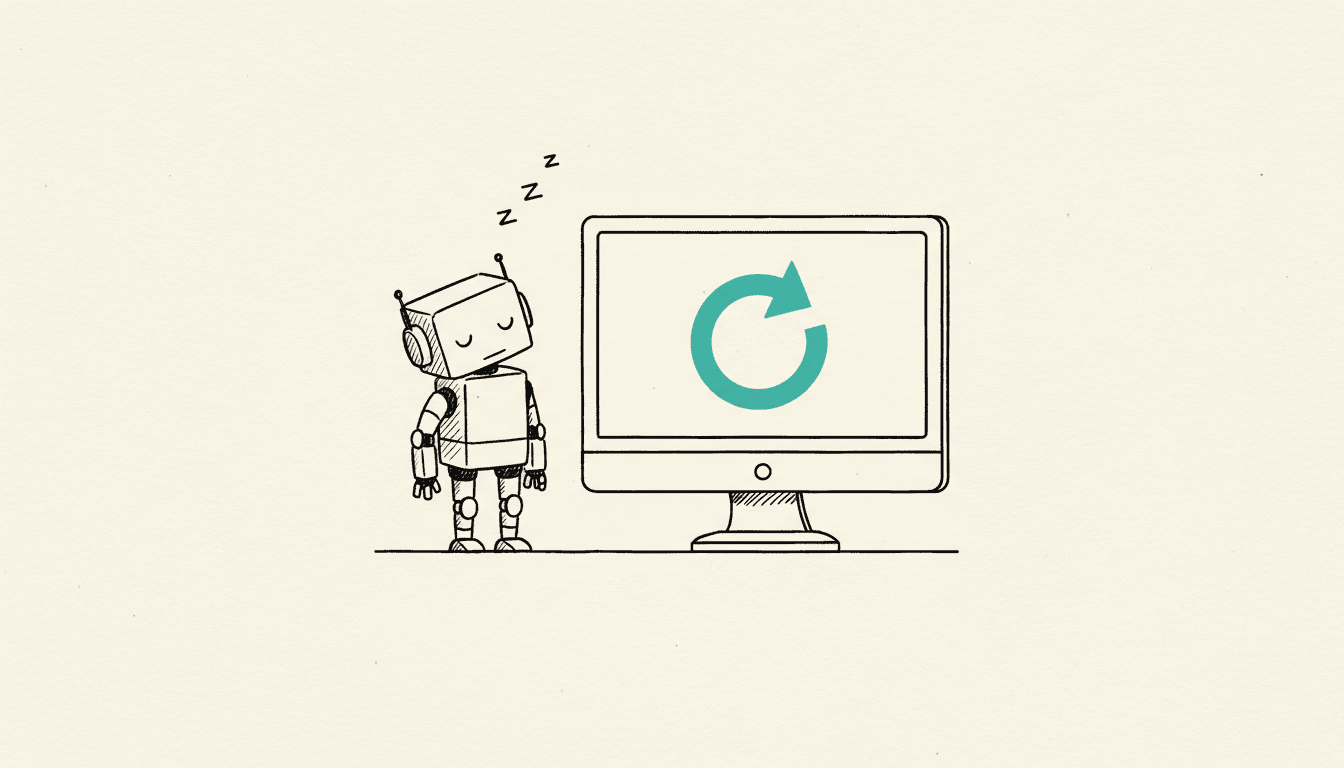
A Windows Update can paralyze your UiPath robots overnight without anyone noticing. Unattended robots work during the hours when no one is in the office. Most organizations' operating system patch maintenance runs fall into exactly this window. In the morning, there is no error, just no result.
Why does a Windows Update paralyze unattended robots?
An unattended robot needs three things, and an update can change all three: a running Windows session, an unchanged interface of the target application, and an accessible machine.
The reboot is the obvious part. The less obvious part is the logon afterward. UiPath documents several Windows policies for unattended scenarios that prevent automatic logon. The policy "Display information about previous logons during user logon" generates a security pop-up during logon and causes the robot to fail with error code 0x80070520; it must be set to Disabled. Also, "Sign-in and lock last interactive user automatically after a restart" interferes with session creation and should not be configured or disabled (Source: UiPath Robot, Session troubleshooting).
When do updates come? The Microsoft rhythm in detail
Microsoft releases monthly security updates for Windows on the second Tuesday of every month, typically at 10:00 a.m. Pacific Time. However, anyone who only knows this date knows only two-thirds of the cycle.
According to Microsoft's own overview of the update release cycle, there are three relevant triggers for unscheduled restarts (Source: Microsoft Learn, Update release cycle for Windows clients):
- Monthly security update: second Tuesday of the month, cumulative, classified as mandatory by most organizations.
- Optional preview update: fourth Tuesday of the month, not security-related, serves early validation of the upcoming security update.
- Out-of-band release: as needed, without a fixed schedule, when an acute vulnerability must be closed.
A schedule that only blocks the second Tuesday does not cover the fourth Tuesday and out-of-band releases.
Why do selectors break after an update?
Selectors identify a control element via its properties in the window tree. If an update changes these properties, the robot can no longer find the element, even though it looks unchanged to a person.
UiPath lists several causes in troubleshooting selectors, three of which are directly related to updates (Source: UiPath, Troubleshooting selectors):
- Broken selectors after browser updates: Browser updates change the structure of the rendered page. Updating the Activities packages is recommended.
- UI changes in target application: A feature update of the business application moves nodes or attributes. Solutions are adapted selector nodes or Unified Target with computer vision fallback.
- Differences in the environment: Test and production run with different scaling. UiPath recommends consistent 100 percent scaling across all environments.
Robust selectors are therefore not optional, but the cheapest insurance against patch days. Wildcards for dynamic parts, stable attributes like aaname or id instead of position indices, and anchors instead of rigid paths. The same principle applies across tools; we have described it in more detail for the Microsoft side in robust selectors and wait times in Power Automate Desktop.
How do you align update windows and robot schedule?
Update windows and robot schedules must not overlap, and the update must run first. A robot that starts at 02:00 while the patch reboots at 02:30 loses its run mid-transaction.
Microsoft recommends a staggered patching plan for virtual machines that can be transferred almost unchanged to robot machines: development on the second Tuesday, testing on the second Wednesday, production only on the second Saturday or the following Sunday (Source: Microsoft Learn, Scalable Windows virtual machine patch management). The days in between are the validation window.
In practice, this means: disable or reschedule triggers for the patch night beforehand, place the reboot in a window with no running jobs, and start a small validation process before the first production run.
How do you know a robot is down before the customer does?
The Orchestrator reports a robot as Unresponsive if the robot and Orchestrator have not communicated in the last two minutes (Source: UiPath Orchestrator, Robot Statuses). This signal is there; it just needs to reach someone.
The Orchestrator knows the severity levels Info, Success, Warn, Error, and Fatal and delivers messages via four paths: the banner in the interface, the Alerts panel, the Alerts page, and email summaries. Important for night runs is the difference between the two email formats: the ten-minute summary contains only alerts of Fatal and Error levels, the daily summary collects all subscribed events from 10 a.m. local time (Source: UiPath Orchestrator, Alerts).
Anyone who has subscribed to only the daily summary learns of an outage at 02:00 a.m. at the earliest in the morning. For night runs, the ten-minute summary is the right choice, supplemented by a business-level check: a technically green job that moved zero records is the error that no system alarm catches.
In our automation projects, that's exactly the most common gap: technical monitoring is in place, but business-level success control is missing. You can find what NordFlux specifically handles on our page for UiPath consulting and process automation in general.
What belongs in test environment and rollback?
A test environment for RPA only becomes useful if it has the same patch level and screen scaling as production. Otherwise, you're testing a different system and missing exactly the deviation that breaks the selector.
The rollback path belongs before the first patch day. Three points are sufficient as minimum configuration:
- Snapshot before update: For virtual robot machines, a checkpoint immediately before the maintenance window. This is the fastest way back to a functioning state.
- Retain automation version: The last successfully running process version remains available in the Orchestrator so that a rollback doesn't fail due to a missing package.
- Manual backup path: For each mission-critical process, it must be documented how it runs for a day without robots. Without this plan, a patch problem becomes a delivery problem.
Frequently Asked Questions
When exactly is Patch Tuesday?
Microsoft releases monthly security updates for Windows on the second Tuesday of every month, typically at 10:00 a.m. Pacific Time, which corresponds to late evening in Germany. Additionally, there is an optional preview update without security content on the fourth Tuesday and out-of-band releases as needed without a fixed schedule.
Can I simply disable Windows Updates on robot machines?
No, that only shifts the problem and creates a security risk. Monthly security updates are cumulative; a later catch-up brings all missed changes at once, creating greater risk of breakage than regular small steps. A staggered plan with fixed maintenance windows makes sense, not skipping updates.
How do I know a selector is broken by an update?
Typical is an element-not-found error that occurs for the first time right after a maintenance window and always at the same point in the process. UiPath cites causes including browser updates, changed interfaces of target applications, and different scaling between test and production. First check whether the error occurs on all machines or only on those already patched.
Is email notification from the Orchestrator sufficient for monitoring?
Yes for the technical level, no for the business level. The ten-minute summary reports Fatal and Error level alarms promptly, but it doesn't report when a job runs cleanly technically while processing zero transactions. Therefore, supplement with a volume check that compares the actual processing count against an expected value.
What is the first step if robots regularly fail after updates?
Write out maintenance windows and robot schedule side by side and check whether the update is complete before the first run. Usually the sequence is the problem, not the automation. Only after that is work on more robust selectors worthwhile.
Simon Glowik
Founder of NordFlux. Spent four years automating processes at enterprise scale at Dräger, and now brings that depth to the mid-market — pragmatic and with full data sovereignty.
Certifications
- Microsoft certified — PL-900 and AZ-900
- UiPath certified — Automation Developer Associate
- UiPath zertifiziert — Automation Developer Associate
Concrete questions about automation or AI?
In a free initial analysis we discuss your case directly. No strings attached.