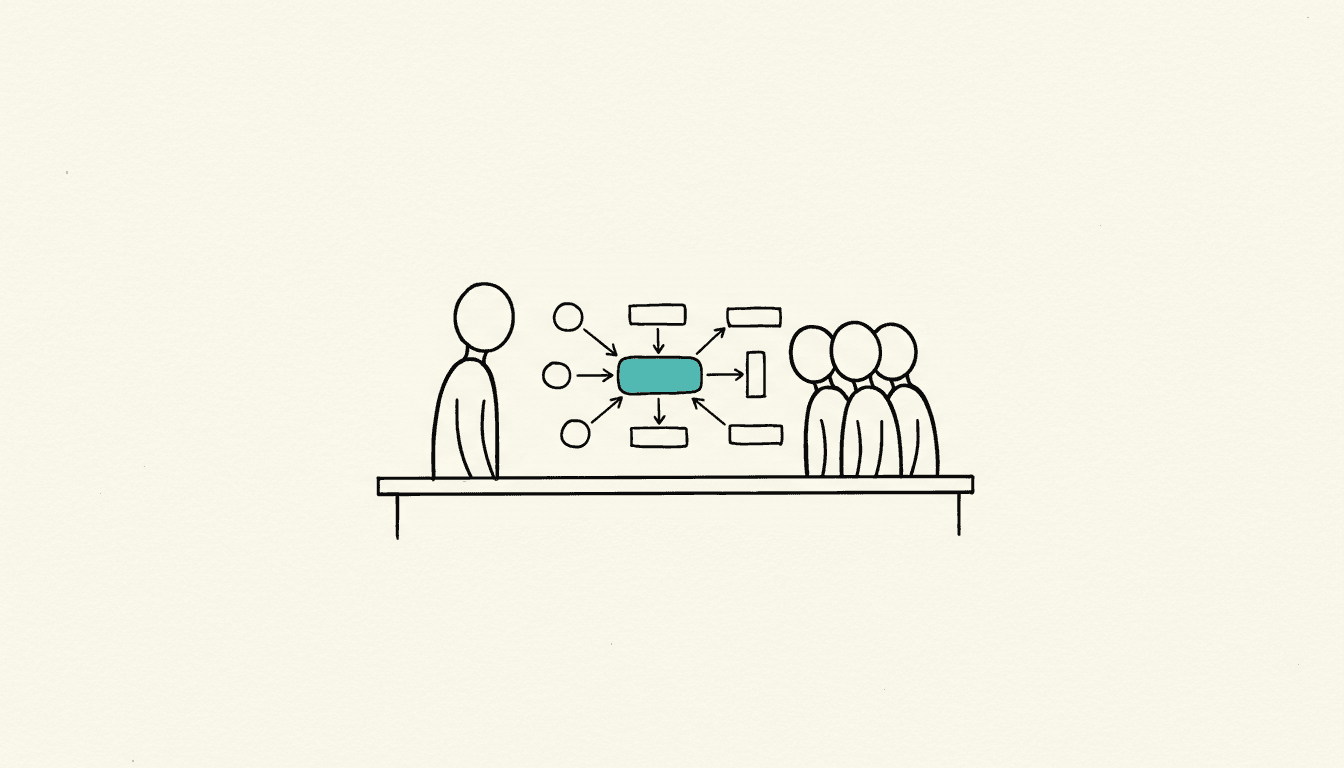
When mid-market companies search for an n8n consultant, they typically encounter two fundamentally different offerings: the solo consultant who builds individual workflows, and the agency that manages an entire automation project with multiple specialists. Both advertise using similar terms like workflow automation, AI integration, or self-hosting, but calculate according to different logic and bear varying degrees of responsibility if a workflow fails after go-live.
In practice, the decision often falls on personal preference or the first offer, not on clear criteria. This backfires later: workflows that no one understands once the original freelancer is no longer available, or agency projects that are purchased unnecessarily expensively for a single, manageable automation.
n8n Consultant or Agency: What Really Differentiates the Two Models?
An n8n consultant is typically a single person with their own calendar, their own workload, and usually a narrow specialty, whereas an agency bundles multiple roles from process analysis through development to support after contract completion. The freelancer is cheaper per hour and faster to reach directly, but has a so-called bus factor of one: if they are unavailable, no one else knows the workflow in detail. The agency costs more overall but can offer backup coverage, knowledge transfer, and contractually guaranteed response times because multiple people know the same client status.
The Four Selection Criteria in Comparison: Price, Experience, SLA, Self-Hosting Expertise
Four criteria determine in practice whether a freelancer or agency is the better fit: the hourly rate or project fee, demonstrable experience with comparable processes, contractually guaranteed availability in emergencies, and the competency to actually operate a self-hosted n8n instance.
- Price
- Freelancer / Solo Consultant: typically 70 to 120 euros per hour, depending on experience and industry. The DACH-wide average across all freelancer specialties is, according to Freelancer Compass 2026 by freelancermap at 103 euros per hour.
- Agency: usually project fee instead of hourly rate, for a single productive workflow often starting from low four-figure range, including testing, documentation, and handover.
- Experience
- Freelancer / Solo Consultant: often specialized in one or two industries or tools, but with deep expertise.
- Agency: bundles experience from multiple client projects, but quality ultimately depends on the specifically assigned consultant, not the agency name.
- SLA / Availability
- Freelancer / Solo Consultant: rarely a written SLA, backup coverage during vacation or illness is usually unclear.
- Agency: can contractually guarantee response times because multiple people know the same client status.
- Self-Hosting Expertise
- Freelancer / Solo Consultant: ranges from years of operational experience to pure documentation knowledge, ask specifically about active reference instances.
- Agency: should actively offer Docker and/or Kubernetes operation, updates, and backups; otherwise only n8n Cloud remains, which is often insufficient for GDPR-sensitive data.
How Does Collaboration Work, From First Conversation to Go-Live?
A reputable n8n project goes through the same five phases regardless of vendor: assessment of the existing process, a concrete offer with effort estimation, implementation in short increments rather than a large big-bang release, a testing phase with real data, and a handover including documentation so the workflow remains maintainable without the original consultant.
What this process looks like in practice at NordFlux is shown on the service page for n8n Automation. Which fundamental questions characterize every reputable vendor, regardless of n8n as a tool, we have outlined separately in Seven Questions to Ask a Good Automation Partner summarized.
What Does an n8n Project Cost in Practice, and Can It Be Subsidized?
A single, clearly defined n8n workflow through a freelancer typically costs a low four-figure amount; an agency project with multiple linked workflows and SLA usually ranges from mid to high four figures.
Add to this the pure n8n license costs: the Community Edition is open source and free to self-host; the cloud variant starts, according to n8n Pricing Page with the Starter plan at 20 US dollars per month on annual billing; the Business plan charges overages at 4,000 euros per additional package of 300,000 executions.
For small and mid-size businesses, part of the consulting costs can be offset through the BAFA grant "Support for Business Consulting for SMEs", provided the commissioned consultancy is listed with BAFA: the subsidy amounts to up to 80 percent of eligible costs depending on region, according to Federal Subsidy Database a maximum of 2,800 euros in consulting costs per application is eligible.
How NordFlux Assesses Freelancer or Agency Needs in the Initial Consultation
In the free initial call, NordFlux first checks whether a single workflow is sufficient or whether multiple departments and systems need to work together. If a single, well-defined workflow suffices, such as for invoice processing, it is often implemented directly and handed over with documentation. Once multiple systems, departments, or ongoing operational responsibility for a self-hosted instance come into play, NordFlux recommends a setup with clearly defined SLA instead of a one-off freelancer engagement.
Jan Oberhauser, founder and CEO of n8n, makes this exact point in a LinkedIn Post on European Tech Sovereignty to make the point: "Self hosting is the quiet feature that makes n8n stick in serious companies. Every automation tool sells ease of use. Very few sell sovereignty." In essence: Self-hosting is the quiet feature that anchors n8n in serious companies because it sells control instead of mere convenience.
Frequently Asked Questions About n8n Consultants and Agencies
What Does an n8n Consultant Cost Per Hour?
Depending on experience and industry, between 70 and 120 euros per hour. The DACH-wide average across all freelancer specialties is 103 euros per hour, according to the Freelancer Compass 2026.
Is an n8n Freelancer Worth It or Should I Go Directly to an Agency?
For a single, clearly defined workflow, a freelancer is usually sufficient. As soon as multiple systems need to work together or a contractually guaranteed SLA is required, an agency is the safer choice.
Can n8n Consulting Be Financed Through BAFA Grants?
Yes, provided the commissioned consultancy is listed with BAFA, through the "Support for Business Consulting for SMEs" program with a subsidy of up to 80 percent of eligible costs, but a maximum of 2,800 euros in consulting costs per application.
What Does Self-Hosting Expertise Mean for n8n Specifically?
That a vendor can actively operate their own n8n instance, including Docker and/or Kubernetes operation, updates, and backups, instead of just configuring n8n Cloud.
How Long Does It Take Until the First Productive n8n Workflow?
For a single, well-defined process, usually a few weeks from assessment to handover. For multiple linked systems, correspondingly longer.