
Who is liable if the AI agent makes an error?
Who is liable if the AI agent makes an error?
Who is liable if the AI agent makes an error? Contract law, liability exclusion, and escalation model explained for SMEs.
Confidence thresholds, human-in-the-loop, logging: How our escalation model prevents an AI Agent error from going unnoticed.

In almost every discovery call, the same question comes up at some point: What happens when the AI Agent gets it wrong? Most providers respond with phrases about "verified models" or "high accuracy". That doesn't answer the actual question.
That's why we lay out transparently how our escalation model for AI Agents is structured: a fixed chain of confidence thresholds, questions to humans, complete logging, and clearly named responsibilities, before an agent goes live at all.
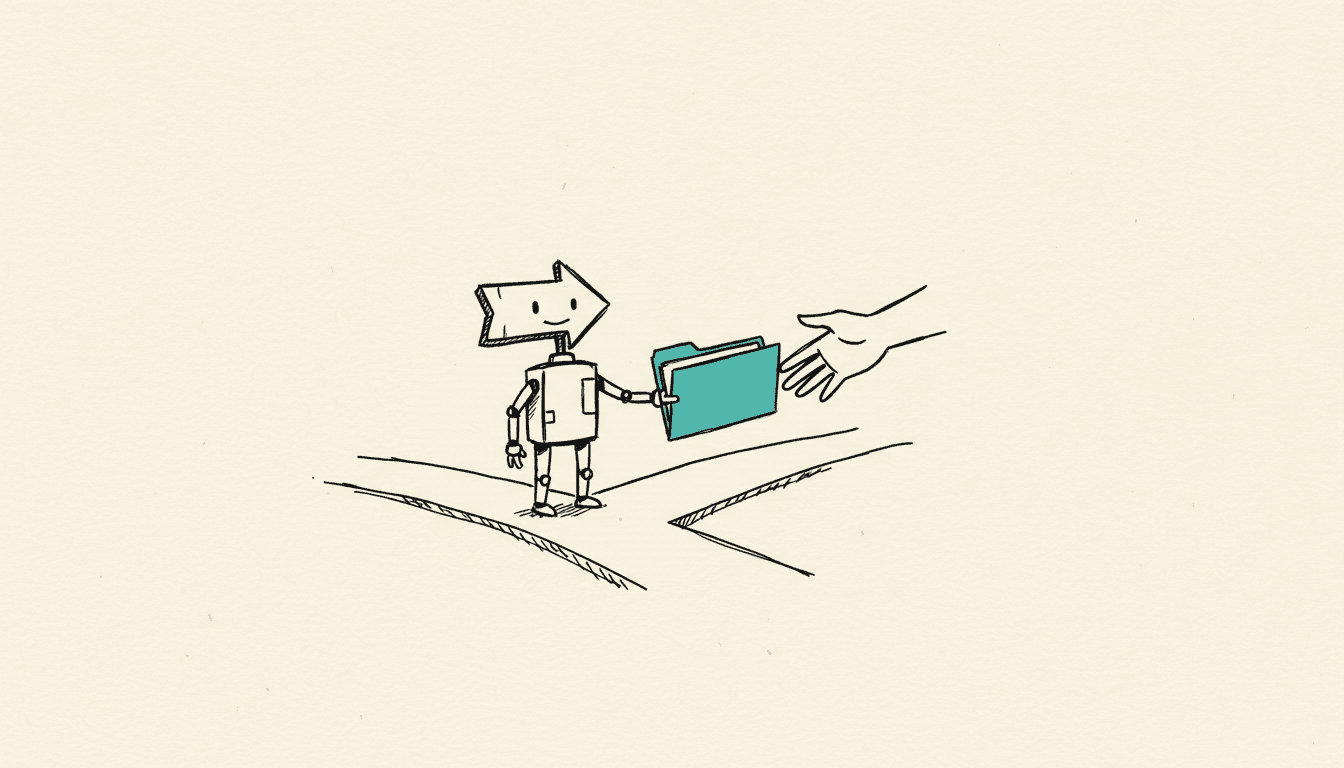
An escalation model defines at what level of uncertainty an AI Agent stops completing a task independently and instead hands it to a human before a decision takes effect. It belongs to the architecture from the start, not as a retrofitted security layer.
The pressure to regulate this cleanly is growing faster than many companies are preparing for it. Gartner forecasts that by the end of 2026, approximately 40 percent of enterprise applications will feature task-specific AI Agents, compared to less than 5 percent in 2025 (Source: //www.gartner.com/en/newsroom/press-releases/2025-08-26-gartner-predicts-40-percent-of-enterprise-apps-will-feature-task-specific-ai-agents-by-2026-up-from-less-than-5-percent-in-2025:Gartner). At the same time, according to a Deloitte survey of 3,235 executives in 24 countries, only 21 percent of companies have a mature governance model for autonomous AI Agents (Source: //www.deloitte.com/us/en/insights/topics/emerging-technologies/ai-agents-scaling-faster.html:Deloitte). This is precisely the gap an escalation model closes.
Confidence thresholds are fixed threshold values at which an agent assesses its own certainty in a decision and acts differently based on that. At high confidence, the agent executes the task and logs it. At moderate confidence, it executes it but marks the case for sample checking. At low confidence, the agent stops before execution and hands over to a human.
In invoice receipt processing, that looks concretely like this: clear invoice data with a known supplier and appropriate coding runs automatically. Unclear coding is marked and checked subsequently. Missing required fields or deviations from the supplier master data stop the process immediately before anything is posted.
Human-in-the-loop means that a task only takes effect after human approval once the agent reaches a defined uncertainty or risk threshold. This is not voluntary, but has since become regulatory anchored in the EU: Article 14 of the EU AI Act requires for high-risk systems that humans can understand, intervene, and stop an AI system at any time (Source: //artificialintelligenceact.eu/article/14/:EU AI Act, Article 14).
With us, it is predetermined who takes on this role: on the customer side, a named contact person who receives and decides on escalations, on the NordFlux side, a technical responsible person who monitors and adjusts the threshold values. Both are specified in the Process Design Document that we align together before go-live.
Every decision an agent makes is logged, regardless of whether it ran automatically or was escalated. The log contains the input data, the determined confidence value, the path chosen, and, if a human intervened, who decided what and when.
This is not an end in itself. Without this log, it is impossible to clarify afterward why an error occurred or whether the threshold values are set correctly. We regularly use the logs to refine thresholds, for example when it becomes clear that a particular type of request escalates more often than necessary or, conversely, too infrequently. More on the technical implementation of such agents can be found in our service area AI Agents, for the classification of governance and responsibilities in AI Consulting.
A craftsman's business that uses an AI telephone assistant with us for call handling is a good example of how this looks in practice. The agent independently handles standard inquiries such as scheduling appointments or general business hours. As soon as it involves short-notice appointment cancellations, complaints, or price negotiations, the agent immediately switches, audibly to the caller, into handoff mode: it openly states that it is forwarding the inquiry to an employee, and hands over with context instead of leaving the caller in a loop.
Each conversation is logged with a note on whether and why escalation occurred. This gives the business a solid foundation to see which topics regularly push the agent to its limit, and to adjust the thresholds accordingly rather than relying on gut feeling.
Even the best escalation model does not prevent every error, it only reduces the window in which an error can cause unnoticed damage. That's why we regulate responsibilities contractually in advance rather than in a dispute: who is responsible for the technical approval of an escalation, who bears liability for the agent's technical function, and which cases should never be automated because the risk doesn't justify it.
An escalation model does not replace this clarification, it only makes it effective. Without named responsibility, every escalation ends up with no one when in doubt.
The agent does not execute the task, but instead hands it over with full context to a named contact person. The handoff and the reason for it are logged.
The thresholds are set together in the Process Design Document before go-live and can be adjusted later based on the log data.
Yes. Every decision is logged, regardless of whether it ran automatically or went to a human.
No. It reduces how often a human needs to intervene, but does not replace the ability to intervene. This is also required by Article 14 of the EU AI Act for high-risk cases.
The principle applies to all AI Agents we build, whether as n8n workflow, Copilot Agent, or telephone assistant. The specific threshold values differ depending on the use case.
Founder of NordFlux. Spent four years automating processes at enterprise scale at Dräger, and now brings that depth to the mid-market — pragmatic and with full data sovereignty.
Certifications
Who is liable if the AI agent makes an error? Contract law, liability exclusion, and escalation model explained for SMEs.
Without clear confidence thresholds and human-in-the-loop checkpoints, an AI agent makes decisions in doubtful cases that nobody can trace, until the error has already caused damage. NordFlux builds every agent project with an escalation model that automatically hands critical cases over to humans and logs every decision traceably. In an initial conversation, we design the escalation model for your specific use case.