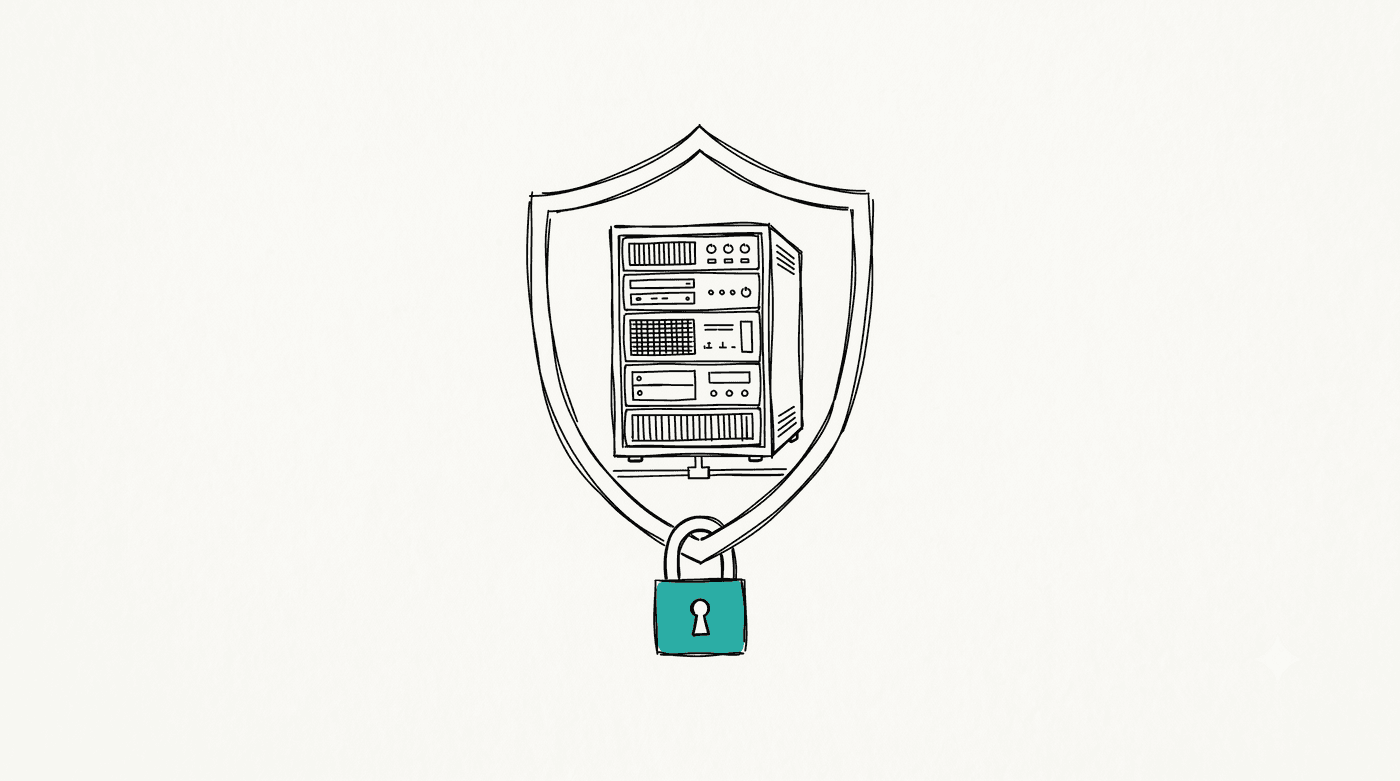
The biggest brake on AI in mid-sized companies is rarely the technology. It's the question: what happens to our data? The concern is valid, and it has a good answer. AI can be used in a way that keeps sensitive data inside your building and leaves you in control.
What data protection is really about
Not every AI is a US cloud service that reads along with everything. Three questions are decisive: where is the data processed? Who has access? And is it used to train someone else's models? If the answers are right, AI is justifiable even with sensitive data.
Data that stays in Germany
There are ways to use AI without any data leaving your control. Tools like
In shortGDPR-compliant AI means: processing in the EU or in-house, clear access rights, and no use of your data to train someone else's models.
Access rights are half the battle
An often overlooked point: AI sees exactly the data the user already has access to. If permissions are messy, an assistant might also show documents it should not. Before every AI project it is therefore worth looking at the permissions, for example in SharePoint. Anyone who tidies up the permissions beforehand closes the biggest silent data protection risk before it arises. This is often the least spectacular but most effective measure in the whole project, and it works regardless of which AI tool is ultimately used.
Especially relevant for public administration and healthcare
For the public sector and organisations handling sensitive data, data sovereignty is not an option but a requirement. How an internal assistant achieves this without any data leaking out is described in our article on the internal knowledge assistant.
Data protection is not an obstacle to AI but the condition under which you can use it seriously.
Three ways to keep the data in-house
Which path fits depends on how much protection is needed. In practice there are mainly three:
- EU cloud: models and services that, by contractual guarantee, run in European data centres. Quick to get started and sufficient for many cases.
- Self-hosted: tools like n8n on a server in Germany, with the data flow remaining under your control.
- On-premise: models that run entirely on your own infrastructure, without any data leaving the building. The path for particularly sensitive areas.
As soon as an external service is involved, a data processing agreement is part of it, recording who processes the data and for what purpose. This is not paperwork, but the contractual side of data sovereignty.
This article is not a substitute for legal advice. It puts into context what is technically possible. The legal assessment of an individual case belongs in expert hands.
What to keep in mind when working with real data
It rarely gets tricky when setting up the technology, but when feeding it with real data. Anyone training a model with customer data or passing entire files in the prompt should observe two principles. First, data minimisation: in many cases it is enough to remove or pseudonymise names, addresses and other personal details beforehand, because the model solves the task without them too. Second, purpose limitation: data collected for accounting does not belong in a sales model without asking. What it was originally there for governs what it may be reused for. In practice this means briefly asking, before every training run, whether the AI really needs the real data or whether an anonymised extract is enough. That is usually the simpler and at the same time the cleaner solution.
Frequently asked questions
Can AI be used in a GDPR-compliant way?
Yes, provided the processing happens in the EU or in-house, the access rights are clean, and the data is not used to train someone else's models. The specific setup is what makes the difference.
Does my data have to go to a US cloud?
No. There are tools and models that run in German or European data centres or entirely on your own infrastructure. For sensitive data, that is the right approach.
Who is liable for data protection?
Your company remains responsible as the data controller. We set up the technology so that it supports this responsibility, and we work through the necessary points together with you.