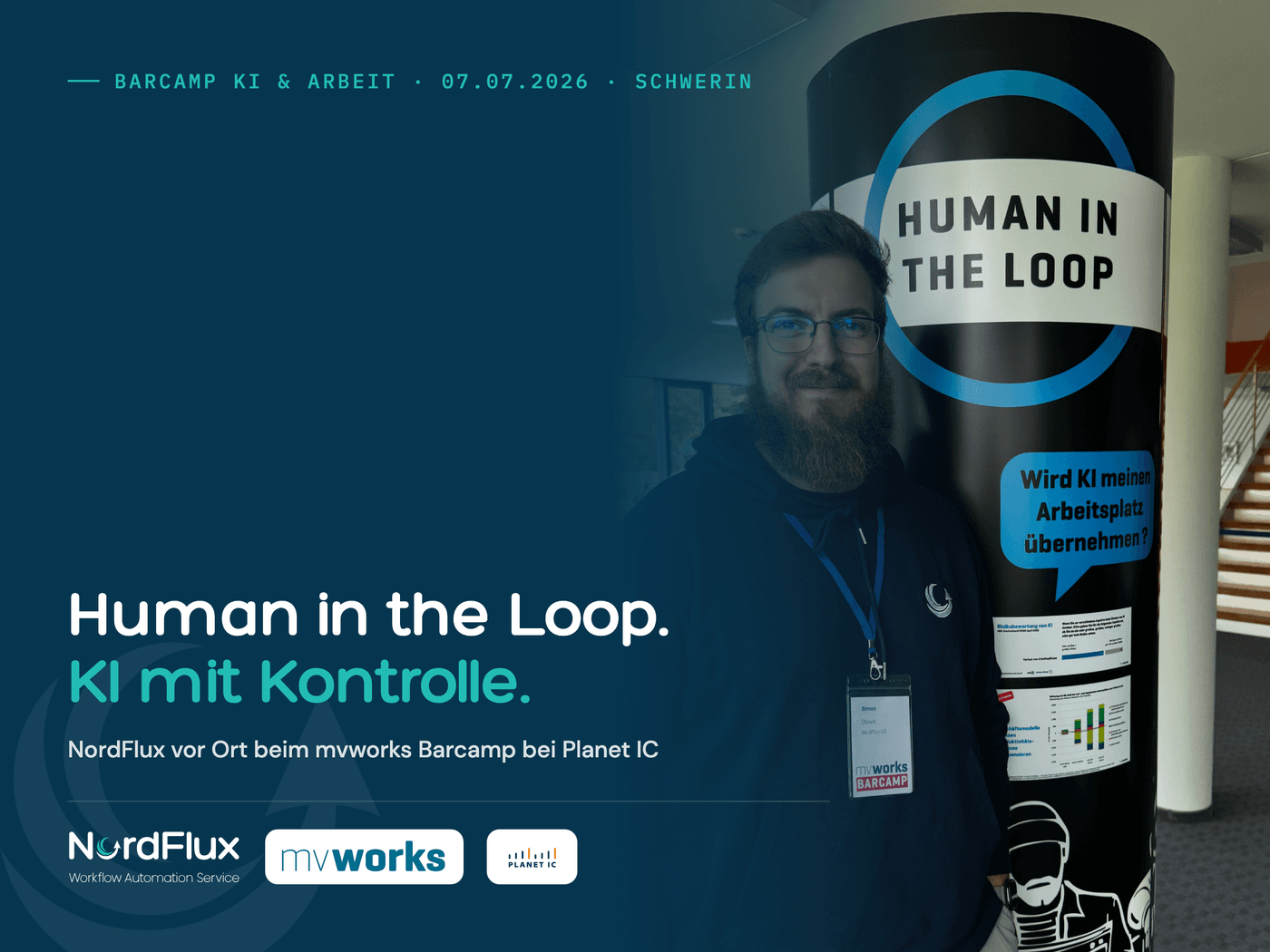
At mvworks Barcamp "AI & Work", on July 7, 2026 at Planet IC in Schwerin, a statement that lingered. The real risk isn't AI, it's the absence of clear rules in a company. Alexander Balow, CEO of Mandarin agency, put into words what we see at NordFlux in almost every first consultation. It's not technology that holds back AI projects, but the open question of who in the company actually decided which data is allowed in an AI tool and which isn't.
That's what AI maturity is about: not the fastest model, but whether your company is prepared to deploy AI in a controlled way. This article shows the four points every company should check before the first AI agent goes live.
Why AI projects fail due to missing governance, not technology
Demand is there, structure is missing. According to Bitkom's 2025 study Artificial Intelligence in Germany, 36 percent of companies use AI, nearly double the 20 percent from the previous year. When asked about the biggest barrier, 53 percent cite legal uncertainty and missing expertise, even ahead of tight staffing (source: Bitkom, AI Study 2025). The pattern is clear: the bottleneck isn't the tool, it's uncertainty about what rules govern its use.
An AI tool is neutral. Whether its use is safe depends on what you feed into it and who is responsible for the results. Whoever clarifies these rules beforehand saves expensive corrections and embarrassing data breaches later. The following four points form the core of every AI readiness effort.
Checkpoint 1: Which personal data can go into an AI tool?
Personal data doesn't belong in a public AI tool without scrutiny. If you paste names, addresses, applications, or health information into a freely accessible chatbot, you lose control of that data, often to a provider outside the EU. The first rule is simple: for personal data, you need either a tool with a data processing agreement and EU processing, or data minimization that removes personal reference before handoff. In many cases, the model solves the task with anonymized extracts.
Checkpoint 2: How do you protect sensitive business data?
Personal data isn't the only data worth protecting; your proprietary knowledge counts too. Recipes, calculations, customer lists, and strategic papers are your company's value, and they have no place in a public AI service that might use inputs for training. The rule: define which data classes stay internal and which an AI tool can see. For sensitive areas, there are models running in European data centers or entirely on-premises, so data never leaves your infrastructure.
Checkpoint 3: Who verifies AI results?
AI can sound convincing and still be wrong. Language models invent facts, what they call hallucinations, with the same confidence as correct answers. That's why every AI output that feeds into a decision or goes external needs human review. The rule isn't to distrust AI, but to build in a fixed checkpoint: who signs off before AI text goes to a customer or an AI analysis goes into a report? A digital employee handles the routine work; the decision stays human.
Checkpoint 4: Who's accountable? Governance and responsibility
The first three checkpoints only work if someone is responsible for them. Without named accountability, every rule applies to everyone and thus to no one. Governance here means nothing bureaucratic: a concise internal policy stating which tools are allowed, what data can go in, and who decides in case of doubt. Half a page usually suffices. What matters is that one person or role owns it, so new AI applications are checked against the same rules instead of every department quietly using its own tool.
Kurz gesagtAI maturity isn't a technology question; it's about clear rules: which personal data goes in, how sensitive business data is protected, who verifies results, and who's accountable.
How do GDPR and the EU AI Act fit in?
The four checkpoints are the organizational side. Then there's the legal side. The EU AI Act has been in effect since February 2, 2025, with initial bans in place; since August 2, 2025, violations carry fines up to 35 million euros or 7 percent of global annual revenue (source: European Commission on the AI Act). For most mid-market automation, the situation stays relaxed; we detail it in the article EU AI Act: Is My Company Affected? above. For how to operate AI in compliance with GDPR so your data stays in Germany, read about GDPR-Compliant AI.
AI Readiness: Getting Your Bearings Before Your First AI Agent Goes Live
Good news: these four checkpoints can be clarified in an afternoon. That's exactly the core of our AI Consulting. In an AI readiness session, we walk through your planned AI applications, classify your data, and clarify who decides what. The result is a short, practical policy rather than a rulebook no one reads. That's how AI readiness gives clarity before your first AI agent goes live, and automation handles the routine while your team keeps the decisions.
Frequently Asked Questions
What does AI maturity mean?
AI maturity describes how well a company is prepared to deploy AI in a controlled way. It doesn't measure technology; it measures whether clear rules exist: which data goes into AI tools, how results are verified, and who's accountable.
Which data should never go into an AI tool?
Personal data and sensitive business data like recipes, customer lists, or strategic papers don't belong in a public AI tool without scrutiny. You need either a tool with EU processing and a data processing agreement, or anonymization before handoff.
Do I always need to verify AI results?
Results that feed into decisions or go external should be verified. Language models can invent facts. A fixed sign-off point before use usually suffices; you don't need to duplicate every step.
Where do I start with AI readiness?
With a quick inventory: Where are we already using AI or planning it, what data's involved, who decides? That overview is the foundation for a concise internal policy and shows where action is needed and where it isn't.